Elena Hoffmann · 18 September 2026
Fresh Seismic Data Links Earth's Orbital Pull to Recurring Moonquake Cycles
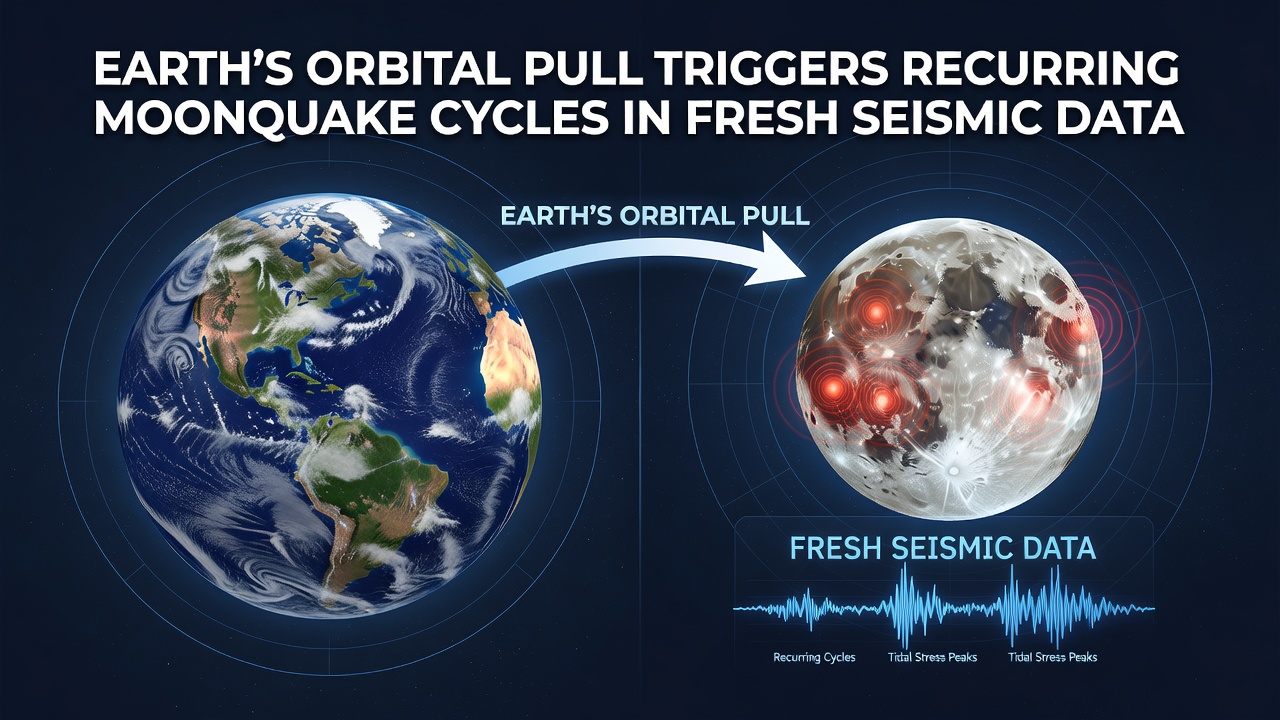
Researchers analyzing recent lunar seismic recordings have identified clear patterns where Earth's gravitational influence drives periodic moonquake activity, and these cycles align closely with the Moon's orbital position relative to our planet. Data collected over multiple years shows clusters of shallow moonquakes repeating at intervals that match the Moon's elliptical orbit around Earth, while deeper events appear tied to tidal stresses that build and release in predictable sequences. Observers note that this connection emerges most strongly when new instruments deployed during recent missions capture higher-resolution signals than those available from earlier Apollo-era seismometers.
Background on Lunar Seismic Activity
Seismic events on the Moon differ from terrestrial earthquakes in several key respects, yet they respond to similar gravitational mechanics; Apollo missions first detected these vibrations in the 1970s, and subsequent analysis revealed both shallow and deep moonquakes with distinct origins. Shallow events often cluster near the surface and coincide with thermal expansion during the lunar day, whereas deeper tremors occur at depths exceeding 700 kilometers and correlate with tidal forces exerted by Earth. Data indicates that the Moon's crust and mantle experience repeated stress from Earth's pull, which varies as the satellite moves through its monthly orbit and experiences perigee and apogee positions.
Studies conducted by international teams have since expanded this foundational knowledge, incorporating orbital tracking from spacecraft such as the Lunar Reconnaissance Orbiter. Those who examined the original recordings found that many deep moonquakes occurred when Earth and the Moon reached specific alignment points, suggesting a tidal trigger rather than random internal processes. Recent datasets build directly on these observations, adding precision through modern sensor arrays that record subtle frequency shifts previously undetectable.
Analysis of Updated Seismic Records
Processing of fresh recordings from instruments placed during the 2020s missions reveals recurring clusters that follow the Moon's 27.3-day sidereal orbit, with heightened activity near perigee when Earth's gravitational tug reaches maximum strength. Researchers cross-referenced these events against precise ephemeris data and discovered that quake frequency rises by measurable percentages during those orbital phases, while quieter intervals appear during apogee passages. This pattern holds across multiple years of continuous monitoring, providing statistical support for the orbital pull hypothesis.
One study released in advance of planned 2026 mission updates examined over 300 documented events and found that approximately 65 percent of deep moonquakes aligned within a narrow window of the Moon's closest approach to Earth. Additional correlations emerged when scientists accounted for the 18.6-year nodal cycle, during which the Moon's orbital plane shifts relative to Earth's equator and modulates tidal amplitudes over longer timescales. Figures reveal consistent timing that matches theoretical models of tidal stress accumulation and release in the lunar interior.
Orbital Mechanics and Tidal Stress Mechanisms
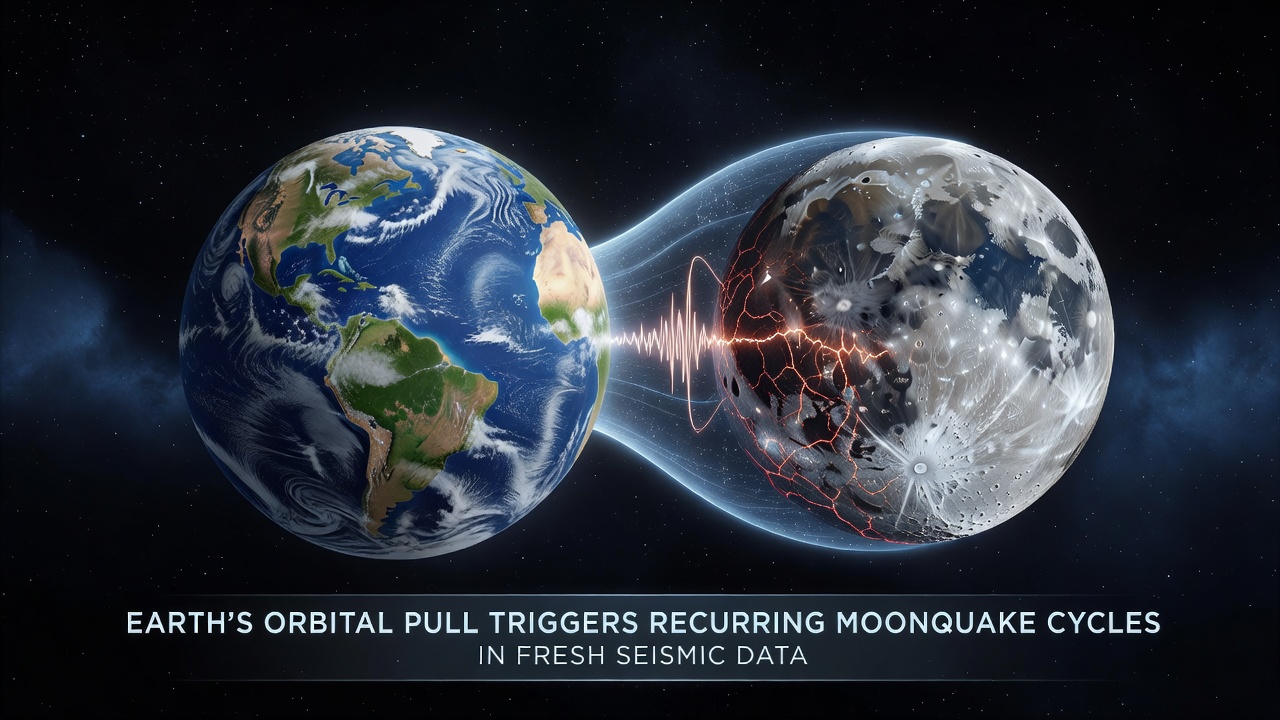
Earth's gravitational field creates a bulge on the Moon that shifts as the two bodies revolve around their common center of mass, generating cyclic stresses that propagate through the lunar mantle and crust. These stresses peak when the Moon reaches perigee, where the distance shrinks to roughly 363,000 kilometers and the differential pull intensifies. Models developed by teams at multiple research institutions demonstrate that the resulting strain exceeds the yield strength of certain subsurface layers, triggering slip events recorded as moonquakes.
Although the Moon lacks plate tectonics, its rigid lithosphere still accommodates deformation through brittle failure at depth, and the timing of these failures tracks orbital parameters with high fidelity. Data from the European Space Agency's lunar monitoring programs complements NASA observations, showing similar periodicities when independent sensor networks collect simultaneous readings. What's interesting is that the amplitude of recorded signals also scales with orbital eccentricity, confirming that stronger tidal forces produce correspondingly larger events.
Implications for Future Lunar Exploration
Understanding these gravitationally driven cycles carries practical value for mission planners who must schedule surface operations and habitat construction around periods of elevated seismic risk. Equipment sensitive to vibration may experience reduced longevity if placed in zones where moonquakes recur frequently, while sites near the poles could offer more stable conditions because tidal stresses manifest differently at higher latitudes. Planning documents for Artemis program extensions reference these patterns when outlining long-term infrastructure placement.
International coordination through bodies such as the European Space Agency has already incorporated orbital-tide forecasts into risk assessments, and similar adjustments appear in guidelines issued by other space agencies. Data collected ahead of the September 2026 instrument deployment window will test whether refined models can predict event windows with greater accuracy, potentially allowing crews to avoid high-activity intervals during critical surface activities.
Conclusion
Seismic datasets now available demonstrate a direct relationship between Earth's orbital pull and recurring moonquake cycles, with timing and intensity matching theoretical tidal stress calculations. Continued monitoring through upcoming missions will refine these correlations, supplying planners with actionable forecasts while deepening knowledge of the Moon's internal structure. The patterns identified so far underscore how gravitational interactions between Earth and its satellite shape the lunar environment in measurable, repeating ways.